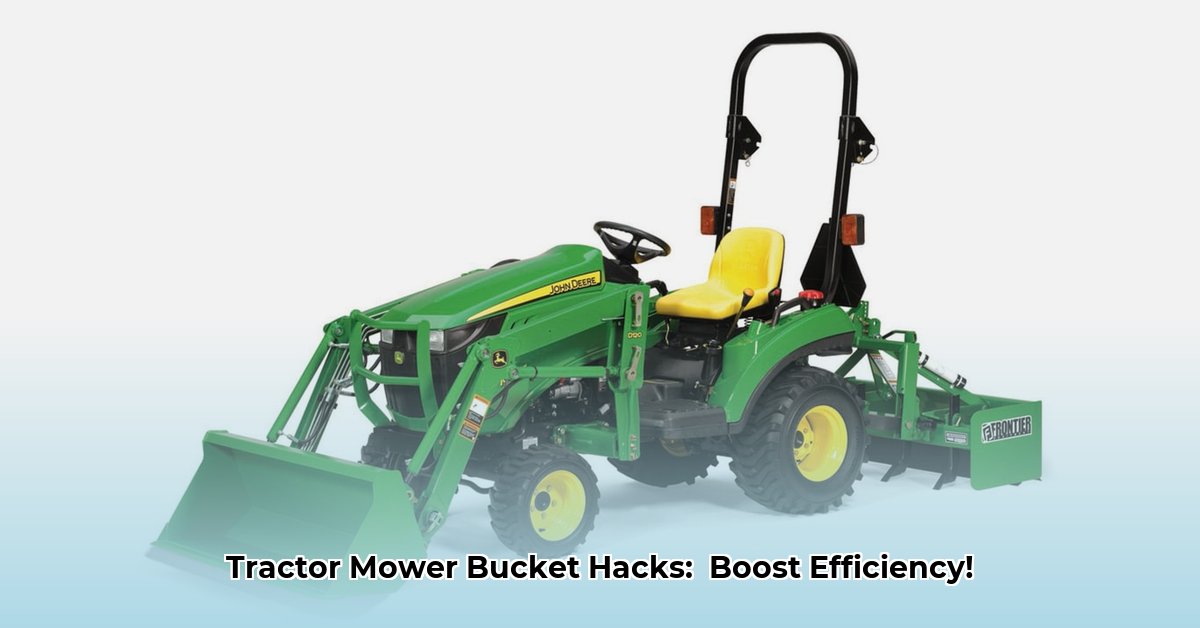
Choosing the right tractor attachment can significantly enhance your land management efficiency. This comparative review analyzes two popular options: Johnny Products and Husqvarna tractor buckets, focusing on their suitability for sustainable homeowner land management. We'll evaluate capacity, ease of use, durability, price, and sustainability impact to help you make an informed decision. For more powerful options, check out this side arm mower.
Capacity and Durability: How Much Can It Haul?
A key differentiator lies in hauling capacity. Husqvarna's 36-inch scoop boasts a stated 200-pound capacity, with precise dimensions (36 inches wide, 14 inches long, 12 inches high) and a lift height of 5 to 7 inches. Johnny Products claims their bucket moves "large (400-pound) rocks," but lacks specific dimensions and lift height details. This lack of precise information makes a direct comparison challenging. For homeowners frequently moving heavy materials, this lack of detail from Johnny Products is a significant drawback. Will you primarily be moving light mulch, or do you need the capacity to move heavy stones or soil?
Ease of Use and Instructions: How User-Friendly Is It?
Both companies advertise user-friendliness. However, Husqvarna provides comprehensive operating instructions, a crucial advantage for users unfamiliar with tractor attachments. Johnny Products offers limited instructions, potentially increasing setup time and the learning curve. Consider your technical aptitude; do you prefer detailed guidance or a more intuitive approach?
Durability and Lifespan: Built to Last?
Both Johnny Products and Husqvarna emphasize durability. Johnny Products highlights "US manufacturing and long-term durability," but lacks quantitative data supporting these claims. Husqvarna offers less detailed material specifications, which hinders a thorough comparison. Do you prioritize a strong reputation for durability or access to specific material and construction data?
Price Point: What's the Investment?
Pricing varies based on retailer and sales. However, the initial investment for Johnny Products is likely higher given their claims of superior capacity. Consider the long-term cost: will a potentially longer-lasting, higher-capacity attachment justify the added upfront expense? This depends entirely on your usage frequency and project scope.
Sustainability Impact: Eco-Friendly Considerations
Both attachments reduce manual labor, benefiting the environment. However, a comprehensive comparison of their environmental impact (manufacturing processes, materials) requires further analysis. Is minimizing your environmental footprint a primary concern in your purchasing decision?
Feature Comparison: Johnny Products vs. Husqvarna
| Feature | Johnny Products Bucket | Husqvarna 36" Scoop Attachment |
|---|---|---|
| Claimed Capacity | Moves "large (400 lb.) rocks" (unverified) | 200 lbs |
| Dimensions | Not specified | 36"W x 14"L x 12"H |
| Lift Height | Not specified | 5"-7" |
| Ease of Use | Limited information; potentially steeper learning curve | Detailed instructions provided |
| Durability | Claims US manufacturing & long-term durability | Material specifics less detailed |
| Price | Generally higher | Generally lower |
| Sustainability | Potential for reduced labor, needs further analysis | Potential for reduced labor, needs further analysis |
Conclusion: Choosing the Right Attachment
The ideal choice depends on your specific needs and priorities. Husqvarna provides comprehensive information and is suitable for homeowners needing a precise understanding of capacity and ease of use. Its detailed specs allow for confident task assessment. Johnny Products may appeal to those prioritizing potentially higher capacity and a reputation for American manufacturing, though the lack of detailed specifications is a significant drawback.
Consider these key factors: Your budget, the frequency and intensity of use, the types of materials regularly moved, and your comfort level with machinery. By carefully weighing these factors, you can select the attachment that best optimizes efficiency and sustainability for your individual land management needs.